Tax breaks for individuals worsen, at the expense of business plans
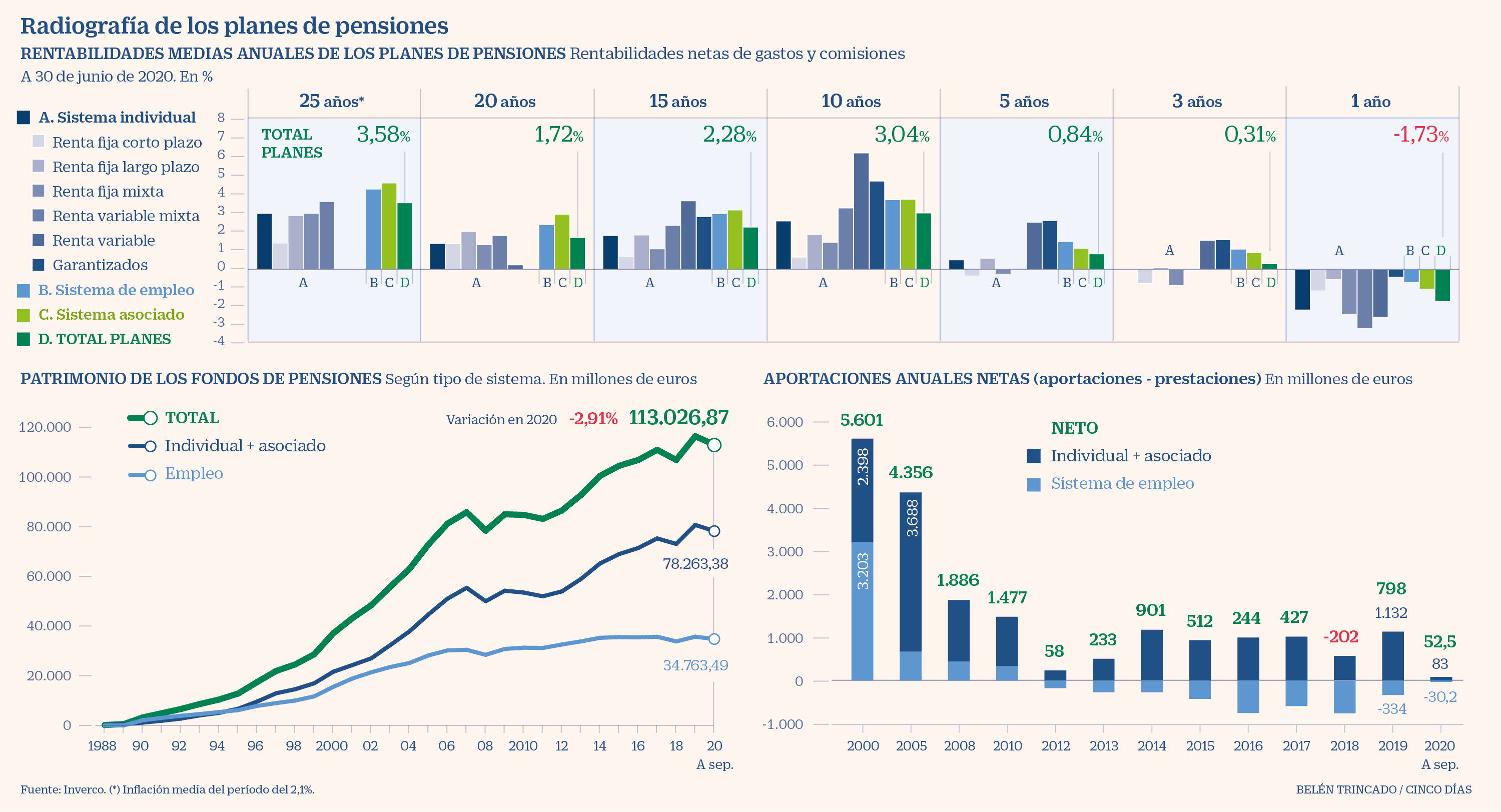
The Government wants to reform from top to bottom the retirement savings instruments: pension plans and their insurance equivalent, the insured pension plans (PPA), which have the same regulation. The Executive intends to modify the system of tax deductions for these products, so as to give priority to collective pension plans (agreed, until now, within large companies and Public Administrations), while at the same time worsening the tax system for individual pension plans.
Until now, any person could contribute up to 8,000 euros a year to a pension plan and deduct this amount from the taxable income tax base (IRPF). For high-income taxpayers, these contributions could greatly alleviate the tax bill because this deduction went directly to the marginal tax bracket, which can exceed 45%. Thus, the tax savings could exceed 3,600 euros per year. And the 8,000 euros of tax benefits for contributions included those made to the company pension plan.
According to the Budget presented this week, the tax incentive for saving in individual pension plans is drastically reduced, from 8,000 to 2,000 euros. In exchange, the joint limit for contributing to an individual and a company plan is raised to 10,000 euros. Thus, to take full advantage of the tax benefit in 2021, it would be necessary to contribute 2,000 euros to the private plan and another 8,000 euros to the company plan. Although the lowering of the ceiling on contributions to an individual plan is very significant, the fact is that most of those who have it never manage to exceed 2,000 euros of annual contributions.
Thus, the blind spot of the current taxation of pension plans is that they are more beneficial for high incomes than for low incomes. According to the Independent Authority for Fiscal Responsibility (Airef), 37% of the beneficiaries of pension plan tax breaks belong to the top 10% of taxpayers.
The problem will arise for those who wish to continue saving for retirement in their pension plan and do not have a company plan. As long as they do not have this option, this tax change will therefore force savers to diversify their investment instruments for retirement, and managers to improve the attractiveness of pension plans, which are often not very profitable and have fees that are too high in proportion to their results.
"The problem with pension plans is that most of the savings are in very large and very unprofitable plans," says Paula Satrústegui, a wealth advisory partner at Abante. Investment funds are a clear alternative and have a not inconsiderable taxation. They allow the transfer from one vehicle to another without paying tax on unrealized capital gains, and at the time of redemption, the tax is not that of earned income, as is the case with pension plans, but that of savings, which ranges from 19% to 23%. And 26% for gains exceeding 200,000 euros in 2021.
The change in the taxation of pension plans will also influence the financial planning of inheritances. Often, and especially for higher incomes, the pension plan is a formula with which to inherit financial wealth, since the beneficiary of the plan at the death of the holder will not pay inheritance tax. It will be paid at the marginal rate when the plan is surrendered. In addition, if the holder of a private pension plan continues to make contributions to the plan -with its consequent tax benefit- once he/she retires, this money will no longer be for him/her but for his/her heirs.
The increase in the maximum rate for the highest incomes will also be another important element when deciding whether to withdraw from the pension plan. Benefits are taxed at the marginal rate, which in 2021 will rise to 47% for incomes above 300,000 euros. And although the plan's redemption is usually made when the participant has already retired and therefore his or her marginal is lower and has moved away from the maximum, it may be advisable to bring the collection forward to this year. Especially if you already have other income, such as rental income.
The tax benefit of the 40% reduction for withdrawals in the form of capital for the amount contributed up to December 31, 2006 is maintained. This tax benefit can only be applied if the plan is redeemed in the year of retirement or in the following two years, so that those who retire in 2020 will have to consider whether to redeem the plan this year, not only to take advantage of this 40% reduction, but also to pay less tax if their income exceeds 300,000 euros.