
The General Directorate of Traffic (DGT) has warned of a new phishing campaign in whichhackers use false information to pressure the user to pay a fine that, in reality, does not exist.
This type of deception is done by e-mail and the DGT itself has specified that, except by exception, 'it does not communicate fines via e-mail'. This issue is important to keep in mind to avoid online scams currently circulating in our country.
Phishing attacks are usually camouflaged behind well-known institutions and companies such as, for example, the Post Office, Amazon, banks or, as in this case, the DGT. Their intention is to gain the trust of the victims in order to steal personal data, money or even infect their devices, also known as spoofing.
En el caso del engaño de las multas de tráfico, estos piratas informáticos utilizan elementos cada vez más elaborados como incluir un enlace donde, supuestamente, descargar información sobre la multa e incita a hacerlo en la mayor brevedad posible con frases como «Advertencia importante«.
It is important that users avoid using links or downloading any documents when in doubt as to whether or not they are suffering a phishing attack.
It is not the first time that the DGT has been affected by scams via email or SMS on its behalf, so it has shared an image on twitter where you can see a fake email to alert users and that, above all, exercise extreme caution.
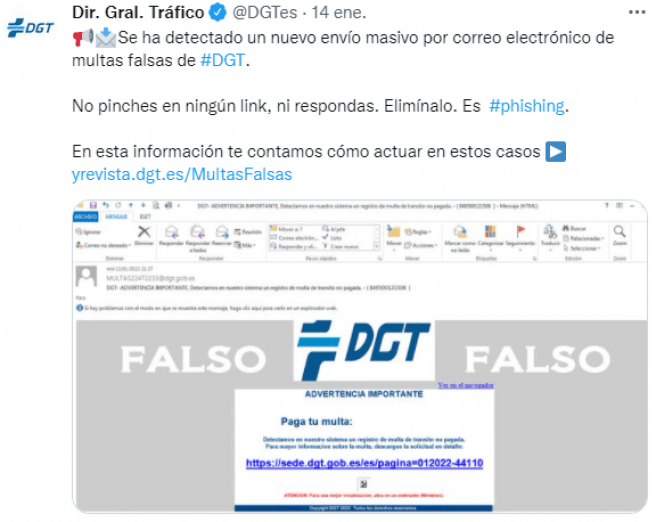
In addition, if the e-mail is analyzed in detail, it is possible to find signs of the scam, although it is true that cybercriminals are taking more and more care in the details to deceive their victims.
Details that indicate the possibility of a phishing scam:
- The shipping address does not appear to be official. Even if we find the acronyms 'dgt' and 'gov' it should not confuse us.
- Some words are not common in our vocabulary. The word 'tránsito' is not normally used in Spain to refer to traffic.
DGT does not send e-mails
The Dirección General de Tráfico only sends e-mails to drivers in Spain if they have voluntarily registered with the Dirección Electrónica Vial (DEV).
DEV is an electronic mailbox for receiving such notifications. This service does send SMS and mails, however, even in this case the following precautionary measures should also be taken.
The fine can be consulted in the TESTRA, without using any link or extra document, the driveronly needs to use his DNI, NIE or CIF to check if he has any pending fine.
Finesare usually served by letter. Occasionally delivery may fail if the address has been changed and notification has not been given.
The DGT app saves the driver's license and other data in the cell phone, which can also be a good source of verification.
In the case of having been a victim and having accessed the fraud, it is important to report the facts to the police and to the respective banks to stop the use of the accounts that may have been compromised.
In addition, having a good antivirus is of great help to detect the entry of all kinds of malware and spyware.
The DGT and INCIBE (National Institute of Cybersecurity) shared in September 2021 a series of tips that should always be remembered in any case that arouses the slightest suspicion.
Source: 20 minutos