Allows the assets to be converted into an income to supplement the public pension on a monthly basis.

Life annuities are an ideal instrument for supplementing the public retirement pension, alleviating the pressures on the public pension system and contributing to its sustainability, given that increasing longevity requires a pension effort from everyone. For this reason, and because they guarantee a standard of living to those who receive them because they are insured, no matter how long one lives, they are an instrument which, according to data from the insurance employers' association, Unespa, are gaining ground as a complementary pension system.
Life annuities, like other annuities, are an excellent alternative when it comes to making savings available after retirement, because they are a good choice:
- This is an excellent product for supplementing public pensions (retirement, widowhood, etc.).
- They reduce and defer the tax burden, which in many cases can be substantial, as opposed to receiving the benefit all at once.
- They make it possible to preserve the estate for potential heirs.
- They guarantee a periodic income to the insured, with the periodicity established by the insured: monthly, quarterly, semi-annually or annually.
- They may have significant tax advantages.
- In the current economic climate and in an environment of rising interest rates, the profitability of life annuities benefits, since the benefits to be received by the policyholder are increased.
What exactly are annuities?
Annuities are a type of insured annuity, i.e. a life insurance policy. Under this insurance, annuities are received until the person dies.
This is the perfect product to build up from a pension plan. That is to say, when a person is in the savings accumulation phase of life, many products are available: pension plans, funds, PIAS, among others. But when they reach the phase of deaccumulating their savings, which may be after retirement or years after they have retired, the options are reduced. One of the best alternatives are life annuities.
These are annuities for life, constituted from pension savings made gradually during the entire working life or from a previously generated patrimony. They can be:
- Not consuming the capital contributed, allowing the beneficiaries to receive the total amount saved in the plan (the income will be lower). There is also the possibility that the amount may be increased by a percentage for death coverage (5%, 3%, etc.).
- Consume the capital contributed, causing the beneficiaries to receive the difference between the amount saved and the amount of the annuities already paid or an agreed percentage of the capital contributed. These are life annuities with reimbursement.
- Continue to be paid to a beneficiary (usually the spouse) in full or in a percentage until that beneficiary dies. These are called reversible annuities.
- Extinguished at the time of death without the potential beneficiaries receiving anything. They are known as pure annuities.
Tax advantages of annuities
Annuities guarantee a standard of living to those who receive them because they are insured, no matter how long you live. Thus, they prevent a person from outliving his or her savings.
The tax advantages will depend on the origin of the money saved:
- If the annuity is constituted with money from a savings product that is not linked to the pension plan (account, deposit, savings insurance, etc.), the yields generated will be considered as income from movable capital in IRPF. In this case, they benefit from excellent taxation since they taxed only on a percentage of the income received. This percentage is established according to the age when the rent begins to be collected.

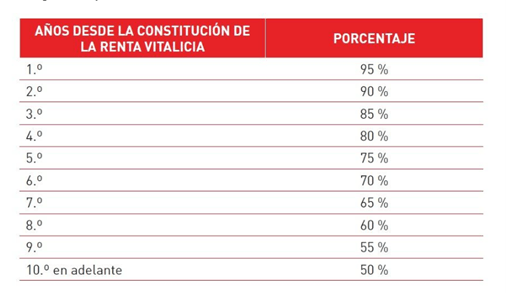
In the particular case of individual systematic savings plans or PIAS, the accumulated return will be exempt from taxation provided that the benefit is received in the form of an annuity.- If the money comes from the transfer of an asset, such as the sale of a property, mainly, or also the sale of investment funds, the gains obtained will be considered as capital gains in the IRPF. Since 2015, life annuities enjoy an additional sale, and it is the total exemption for over 65 years of age of the capital gain generated by the transfer of any asset element with a limit of 240,000 euros, if within 6 months the amount of the transfer is destined to constitute a life annuity. As a requirement, the annuity must have a collection periodicity of less than or equal to one year, begin to be received within one year from its contracting and the annual amount of the annuities may not decrease by more than 5% with respect to the annuity of the previous year. In addition, for contracts as from April 1, 20019 there can only be one beneficiary in the event of death, if there is a guaranteed collection period its duration cannot exceed 10 years and in cases where there is insured capital for death, this capital cannot exceed these percentages:

- If the money comes from savings accumulated in a pension plan or insured pension plan (PPA), the receipt of the benefit will be considered as earned income for personal income tax purposes. In this case, the payment in the form of an annuity is an interesting option to defer the tax impact.