The effect of inflation on the global economy is taking its toll on insurers. However, companies also note that the escalating prices may have a silver lining for their interests. A study by a major global reinsurer analyzes this situation and details what is the best side of the coin for insurers and also what is the worst.
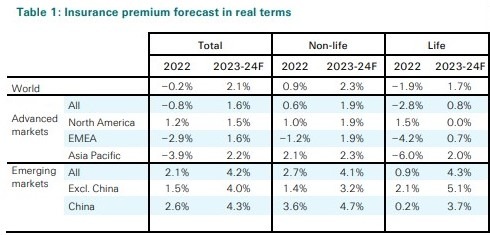
According to the latest sigma study by the Swiss Re Institute, inflation remains the main concern for insurers. Mainly because of the effect that inflation in the global economy is having on the total premium volume worldwide. According to the Swiss reinsurance institute's estimates, global premium income is declining in 2022. However, only slightly, by around 0.2% in real terms.
Looking ahead, the Swiss Re Institute expects the insurance industry to return to premium growth of 2.1% per annum on average in real terms in 2023 and 2024. According to the Institute's predictions, this increase will take place as inflation eases - as all international organizations point out -, the market in the Property and Casualty lines hardens and the demand for Life insurance increases.
According to the Swiss Re Institute, major economies - especially in Europe - are likely to face inflationary recessions in the next 12-18 months amid higher interest rates. And, in this regard, it forecasts global GDP growth to slow to 1.7% in 2023, down from 2.8% in 2022.
The Swiss Re Institute also forecasts average annual CPI inflation of 5.4% in 2023 and 3.5% in 2024, compared to 8.1% in 2022. Although moderation is expected, inflation will remain volatile and will remain above historical averages.
For insurers, inflation is a challenge because it erodes nominal premium growth, affects overall demandand generates higher claims costs in Non-Life lines.
Non-Life, as well as the
Non-Life is the segment that is suffering the most from inflation. Even so, Swiss Re Institute believes it will experience growth of 0.9% in real terms in 2022 globally. Like the industry as a whole, as discussed above, the global Non-Life premium volume will recover in 2023, growing by 1.8%, and will continue to improve in 2024 with a 2.8% increase. In Europe, this expected rebound will occur as the region recovers from the looming recession. However, the Old Continent will not play a determining role in Non-Life, a role reserved for the US and Asia, with China leading the way. The Asian giant accounts for 60% of Non-Life premiums in emerging markets and forecasts real Non-Life premium growth of 4.0% in 2023 and 5.8% in 2024.
Commercial lines are expected to benefit the most from rate tightening and expand more than personal lines (excluding health) in the coming years. Swiss Re Institute estimates a 3.3% growth in commercial premiums in 2022 and a 3.7% increase in 2023. In contrast, it predicts that global personal lines insurance premiums will decline by 0.7% in 2022, mainly due to the underperformance of Motor insurance in advanced markets. By contrast, in 2023, they will recover to 1.8% growth.
Vida, in the same line
For Swiss Re Institute, the cost-of-living crisis in advanced markets has led to a contraction in global Life premiums of 1.9% in real terms in 2022. For 2023 and 2024, real premium growth of 1.7% is forecast, driven mainly by 4.3% growth in emerging markets, including China.
The drivers of Life premium growth are divergent in advanced and emerging markets. Inflation in advanced markets, especially in Europe, is reducing household budgets and thus consumer demand for individual savings products. Meanwhile, in emerging markets, the growing middle class and government targets for life insurance penetration are supporting the growth of savings business. Demand is also favored by younger consumers in emerging markets, who are more aware of the advantages of having long-term life policies.
The positive side
So, on the negative side of the coin, insurers are seeing the stricter side of their business suffering as a result of high inflation.
But, according to Swiss Re Insitute, there is a silver lining for the insurance industry in this situation of economic crisis that is being suffered and comes from the interest rate hikes of the Central Banks to curb high inflation. If they continue to rise over the next few years, this will have a medium-term positive impact on the investment results of the insurance companies, as their assets will be revalued. This is the positive side of the coin.