The source of the damage!
Today, as a result of the tightening of the market that we have been dragging since 2018, we find ourselves more than ever with little or no capacity to commercially influence Insurers to improve their underwriting policy towards our clients, beyond small concessions that are by no means sufficient to solve our placement problems.
The current situation is characterized by an already long persistence of a hard market (this year is the fourth year of sustained and uninterrupted premium growth), and because the socio-economic, political, health and environmental circumstances in the world are changing the insurance market in a journey of "No return".
The question is, are the other players in the insurance process prepared for this change, have we instructed our clients to prepare for a totally different situation in the medium and long term, and more importantly, what are we doing to adapt to this demonic situation?
The answer is clearly NO we are NOT prepared! We have been caught unawares and we have not been prepared to give a timely response to our clients. It is curious how traditionally within the insurance brokerage sector we have always blamed the insurance companies when they did not respond to the needs of our clients, clients who, on the other hand, have been demanding better prices and coverages from the brokers year after year, regardless of the state of their company's risks and the scarce investment in risk management on their part.
But it is also true that today the problem of underwriting and insuring risks is not only limited to demonized sectors, such as the food industry or waste management(whether they are well or poorly protected, whether they have had good or bad loss experience), the current problem is aggravated to the extent that insurers are extending their lack of appetite and rejection to risks in other industrial sectors which, although highly exposed, have had a traditionally good loss and risk management track record, such as; Chemicals, pharmaceuticals, plastics processing, paper handling in general, etc.
Therefore, our reflection must be much more profound with respect to this behavior of the insurers, since it is no longer a question of having left without coverage many companies in condemned sectors such as "waste management" or food in general (with or without sandwich enclosures), but now they are generalizing it to those high exposure risks that it bothers them to have in their industrial portfolio of insureds.
Let's see why this situation occurs
If we look at what we learned at school about what was considered a "perfect market", i.e.: free competition; freedom of entry and exit in the market; homogeneity of the product and information and rationality of the agents involved; we can conclude that these four parameters are not present in the insurance sector in one way or another; therefore, this balance of the "perfect market" has been broken.
The breakage of this market perfection in the insurance sector occurs because the insurance companies have had to endure substantial changes in the economic, legislative and environmental environments that they did not expect and that consequently they have had to act to avoid their disappearance and even so some of them have not been able to avoid their disappearance, either by absorption or by merger with other companies of the same name.
Two difficult years for Covid-19
In the coming years, the insurance industry will be profoundly shaped by some Global trends that are in the process of gestation and acceleration, and which we already evidence from 2020 onwards,
The global economic crisis triggered by COVID-19 has also affected the world financial markets, with a permanent history of scenarios that have been playing out in the form of a roller coaster all over the World.
The negative impact on the insurance industry was noticeable already in 2020, premium growth slowed to a meager + 1.2 % growth (compared to more than 4 % preceding year-over-year growths between 2010 and 2020), and insurers' profits fell globally by around 15 % already from 2019 (according to McKinsey's 2022 report).
In the Asian zone, the drop was 36%, although there has been a certain recovery in the past year 2021 in those areas where the generalized vaccines allowed economic activity to resume, at least up to a certain acceptable level.
But despite this timid recovery in the sector in 2021, after a severe impact in 2020 with logistical problems and exorbitant increases in the price of raw materials and claims costs, now in the year 2022 the insurance industry is also facing some difficulty to grow organically in new business or new investments, and they are only achieving growth with increased premiums on assets and policies already in their portfolios, i.e.; the increase in premiums on the portfolio sustains them.
Interest rates have been low in recent years, if not negative, causing little or no contribution of financial yields to the results of insurance companies, and the "combined ratios" of companies close to 100% is what has minimized profit margins.
Regarding the commercial situation, the market has also been pressured by the massive irruption of "insurtechs" with aggressive digital ways of approaching clients and in tough competition with the traditional insurance markets,
. The companies themselves have been forced to enter these insurtechs/comparators where the only element that justifies their existence is the price factor, which puts downward pressure on individual portfolios (the portfolios of large insurers are mainly made up of individual insurance and small businesses in more than 65%).
A quasi-oligopolistic market?
We are now only interested in where the shoe is on the other foot, which is the corporate insurance sector and more specifically in the risks that are now difficult to insure. It is worth noting that there are currently no more than 10 insurance groups in Europe capable of underwriting medium and large industrial risks.
Of these 10 groups, we only have in Spain about 8 groups capable of quoting industrial risks with face and eyes, but almost all of them have exaggeratedly restrictive underwriting levels, with decision-making capacities delegated to their headquarters outside Spain, reinsurance contracts and underwriting policies coming from outside our borders, they have little room for internal maneuver based on the reality of the Spanish market.
Other American markets such as CHUBB and AIG hardly underwrite property risks in Spain, other markets such as XL or RSA only underwrite large risks with severe restrictions in certain sectors, but not small and medium-sized risks, which is the big problem we have on the table in Spain and which represent 95% of the companies in our country.
The recent Insurer M&A Barometer report explained at FTI Consulting's inaugural European conference highlighted the key trends in the Insurer M&A market through to 2021.
We are facing a scenario of continued consolidation in Europe as smaller insurers struggle to meet the capital requirements of Solvency II and other increasingly demanding regulations, have to endure increased operational regulation and higher reporting and compliance costs with the competent authorities in each country and the European Union as a result. (see this specific section on Solvency II below).
Spain has not been alien to these movements, we only have to remember the loss of players in recent years with the mergers of Catalana/Plus Ultra prior to the merger or purchase of Groupama by Catalana or the disappearance of Tokio Marine from the Spanish market or the elimination of the property & casualty line in Liberty Specialties or the purchase of Catlin by XL and in turn the purchase of these by AXA Seguros, not to mention the disappearance of National Swisse when it was bought by Helvetia, or the merger of CIGNA with CHUBB, etc.
Todos estos movimientos se han dado en un rango de 5/7 años atrás y desgraciadamente ha incidido más en aquellas aseguradoras que solían suscribir eficientemente riesgos industriales, dejando solo unas pocas aseguradoras en un estado casi de “Oligopolio”.
Si se dan cuenta, las aseguradoras que desaparecieron impactan directamente en Aseguradoras que suscribían seguros de empresas, ninguno de estos movimientos corporativos ha ayudado a la economía en general más allá de la pretendida, había necesidad de tener mayor fortaleza financiera y mejorar los ratios de solvencia, pero no ha ayudado al mercado, hay menos jugadores y, por tanto, menos competencia, de facto estamos inmersos en un mercado asegurador estrecho en España para negocios industriales, donde además estas aseguradoras no tienen capacidad de decidir sobre la política de suscripción en nuestro País porque se marca desde sus centrales fuera de España con intereses que no están alineados con los nuestros (por ejemplo no tienen en cuenta que en España los riesgos de la naturaleza catastróficos los cubre el consorcio y no la propia aseguradora).
Las aseguradoras que no pueden o no quieren fusionarse, están obligadas a reestructurar sus carteras, salir de negocios menos rentables o “secundarios” que no les aportan valor o que les consumen muchos recursos, y acometer desinversiones en personal especializado (por ejemplo en suscripción de empresas cuyos salarios son más altos y requieren de más procesos manuales), huyendo todas ellas hacia la digitalización y optimización de procesos y transacciones con clientes y mediadores siempre en los segmentos más estándar o conocidos, por tanto, dejando de lado la profesionalización de los equipos que suscriben empresas más complejas o sofisticadas….. La exclamación tan escuchada de que «ya no hay suscriptores reales» con capacidad de decidir como antes, es real.
In addition to all this, there have been the losses derived from the losses caused by the COVID-19 pandemic, especially in property, where, in addition, global exposure to natural catastrophes has had a major impact.
As a result of this situation, 2021 witnessed a continued increase in Europe in mergers and acquisitions, there were 379 deals, representing an increase of 33% over 2020The total number of transactions of this type amounted to 285.
In 2020, there were also 66 operations of mergers, with the vast majority in the non-life sector. 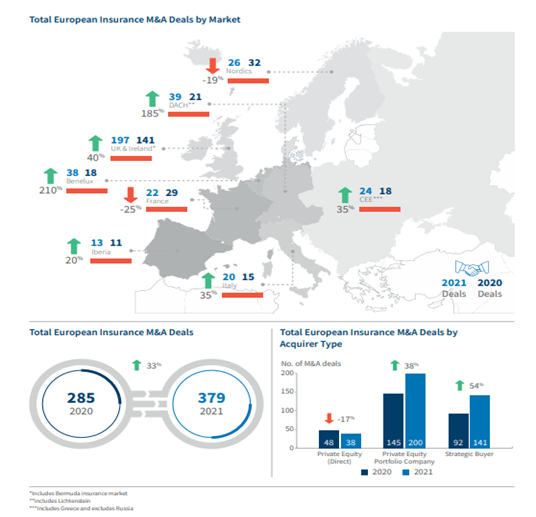
Solvency II, the great regulator
The regulatory requirements of Solvency II (2016) and the new IFRS 7 standard that replaces the previous IFRS 4 on insurance contracts, which creates a new framework based on a single principle for the accounting of all insurance and reinsurance contracts, have forced insurers to focus on profitable business as required by the aforementioned regulations.
Provisioning requirements for assumed and highly volatile risks have restricted the ability of insurers to underwrite large exposures, so we are back to the coinsurance tables of yesteryear due to the limited capacity available to traditional insurers today, which is another problem we have, the available capacity is devoted to known risks,
In fact, many insurers have been forced to lower their financial solvency ratings from "AAA" to "AA" and "A+ A - to BBB- if they wanted to continue operating without having to provision huge amounts of reserves that would guarantee maintaining high ratings with international rating agencies, due to their exposed risks with large and medium-sized companies.
Solvency II has also created a very significant, and in some cases unnecessary, operational burden for insurers. These shortcomings generate negative impacts for consumers, both directly through higher costs and optimal investments and indirectly through reduced product availability and guarantees.
They undermine, according to international financial experts, the international competitiveness of insurers, their natural ability to take a long-term approach to products and investment and their ability to avoid procyclical behavior during a crisis.
The EU, aware of this situation, is reviewing Solvency II in depth, some experts indicate that it should not be a fundamental overhaul of the system, but rather that a limited number of focused improvements to the framework are needed that, taken together, will lead to a justified and necessary reduction in capital requirements and volatility. But today we have what we have and there is no definite date in sight to see the light of these long-awaited modifications.
But the truth is that until this happens,insurers are forced to merge in order to have sufficient strength to meet solvency requirements, reduce their exposures to high volatility risks and abandon secondary or low value-added risks, leaving them to their fate in the market.
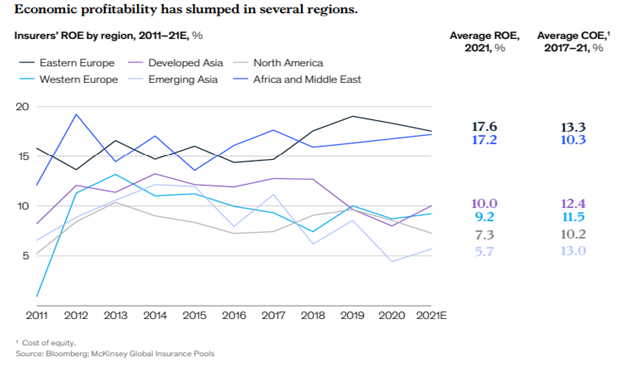
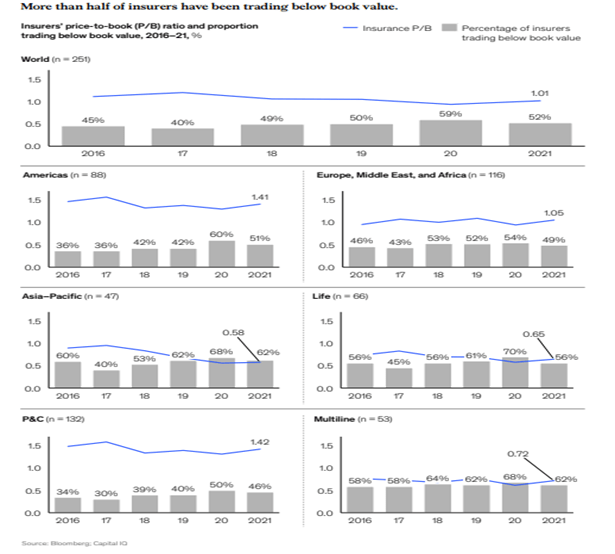
In the McKinsey report of August 20, 2021 on the global insurance market, it is evident (see graph), that as a result of all the above, the profit of insurers in many countries has plummeted, this is not a problem caused by a few underperforming insurers or low profit, it is a global problem of the entire insurance industry.
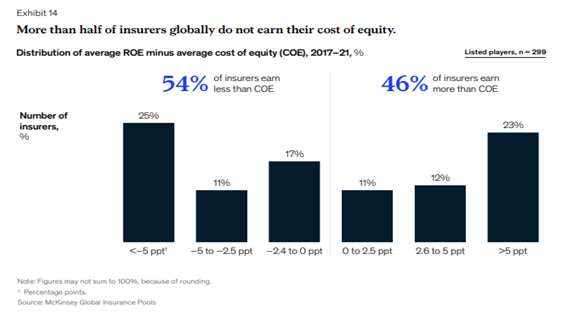
54% of listed insurers, representing 52% of the world's global industry capital, had an ROE below their cost of capital over the last five years (see graph below),
According to McKinsey, about 50% (depending on region and business line focus) of publicly traded insurance companies have traded below their book value over the past five years.
This is clearly a vote of no confidence in the industry and raises questions about the long-term future of several independent insurers.
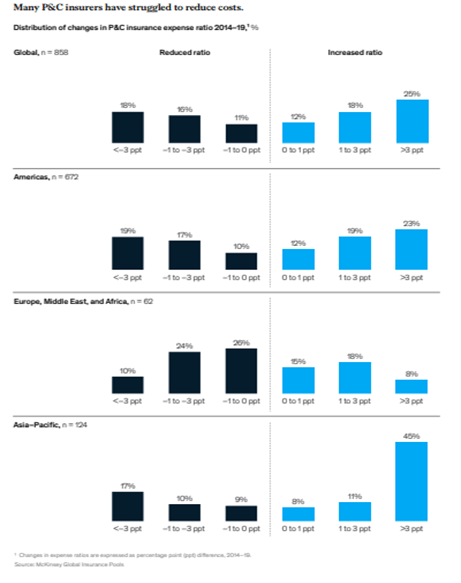
This problem is especially noticeable in individual and small self-employed multi-peril business, where around 60% of insurers have been writing risks below their book value.
In short, after decades of stable returns, insurance is now, as hard as it may sound to say and after all we have seen above, an industry that destroys value and does not create it.
Conclusions
- The insurance market is not to blame for this situation, in any case it has had to react to a perverse scenario where the increase in claims due to climate change, the consequences of the pandemic and the regulation and regulatory requirements derived from the regulators, threaten to make them disappear if they do not comply, especially when they have had to face situations already indicated of pandemic and natural catastrophes, without leaving aside the limited margin of individual businesses due to the digital competition of the "insurtech".
- Insurers have also been forced to take restrictive measures, reducing capacity and avoiding the underwriting of high exposure industrial business with high claims intensity and frequency worldwide. The insurance market is what it is, and whether we like it or not, it is the state of the market that encourages these self-defense policies in order to recover returns that are not what their shareholders require of them.
- Businesses or companies with historical losses and high exposure are not now their insurance targets to recover these returns, whether we like it or not, we have to assume it and it will last for a long time. Especially when the number of operators specialized in small, medium or large industrial business is decreasing as a result of mergers, acquisitions and abandonment of this line of business (disappeared: Liberty, Tokio Marine, AIG, Groupama, Plus Ultra, Catlin, XL, etc.).
- The decision centers of the underwriting policies of the insurance groups are outside Spain, there is little that the branches in Spain can do no matter how much pressure we put on them, they are subject to the dictates of their headquarters abroad and their decisions do not depend on what happens in Spain but on what happens in the larger markets(UK, Germany, USA, France, Japan).
- The proof is what is happening now, where commercial decisions and favoritism to brokers and mediators have almost disappeared, now the aspects considered for underwriting risks are based purely on the correct and strict technical underwriting policy.
- The insurance market will not change even to take decisions aimed at creating "Pool" type insurance groups, we must be realistic, only Mapfre could take a decision of this type, but it needs the participation of the rest of the markets, no less than 20 or 30 insurance companies and now this is an almost impossible task to achieve.
There is the precedent of the Spanish pool of large risks that was cancelled in 2004 when its members decided that they could underwrite large risks on their own without participating in the pool and provide capacity on their own, it was the multinationals that decided to leave and abandon, and consequently the Spanish insurers at that time could not continue alone (Mapfre, Musini and Plus Ultra among them at that time). - The market has changed, we are not going to have markets with soft cycles as in the past, that is over, now companies have to adapt to a much more uncertain and demanding socioeconomic, political, environmental and regulatory situation. Inflation and high interest rates caused directly or indirectly by the war in Ukraine is just one of many events that will undoubtedly come and for which we must be prepared. Swiss Re CEO Christian Mumenthaler has just declared a little more than a month ago the result of a study by his analysis department and recently published in his newsletter "sigma2", entitled "MAINTAINING RESILIENCE: THE ROLE OF INSURANCE COMPANIES IN A NEW WORLD ORDER", which states the new challenges and opportunities to be faced due to the global change resulting from the pandemic and the war in Ukraine, according to them, this has intensified the need for national security and has accelerated the process of relocation, where global food now appears as an important risk to be considered. The most enterprising insurers see this as an opportunity (Swiss Re) but others, on the contrary, apply more preventive and low-risk policies.
- Mediation must take a step forward, to great evils great remedies, enough of complaining systematically because things are not as usual, because they do not adapt to the needs of our clients, or because the insurers do not adapt to our requirements, ,,, it is precisely the other way round!!!!First of all, we are risk advisors and the risks of recent years and those to come are very different, so the transfer to the insurance market of these risks must also be different, in this case more complex and unfavorable compared to recent years where the premiums were not enough to cover the claims. We are instrumental in conveying to our clients the need for better security management policies coupled with an in-depth analysis of the ability to self-insure and retain risks in order to smooth the cost of premiums, which will remain high and will not fall to the levels of the past in the medium term, especially for less protected risks.
What can we do through mediation?
- First of all, to assume the situation, not to resist the dynamics of the market and to explain clearly to our clients the need to adapt and adapt, to explain how difficult it is to place certain risks and the need to invest in risk management and self-protection, today more than ever, and even if the markets do not want to insure us!!!, better to look for self-insurance alternatives than to leave all the responsibility to a market that today may not respond to the needs of our clients.
- We cannot appeal to the insurance compensation consortium either because it would drain private business and turn it into public business and would require a similar effort of advice in the event of a claim without getting any retribution for it.
- The fundamental action that needs to be addressed requires actions by the associations and brokerage associations with advisory units, training in markets and economic forecasts by sector, risk management practices and techniques, and effective advisory methods for our clients.