First to Parliament and then it will be done, because some of the measures will not come into force until 2026 and others will come into force in barely two months. In any case, the package of measures approved by the Council of Ministers is clearly aimed at reducing the accident rate on highways and urban roads. It is the bill that reforms the Law on Traffic, Circulation of Motor Vehicles and Road Safety in the part related to the points-based driving license, in force since 2006.
According to the government, the aim is to promote a new road safety model, in line with the European Union, that will reduce the number of people killed and seriously injured by 50% over the next decade and move towards a figure close to zero by 2050.
In the first place, the bill contemplates increasing the penalties for those behaviors that generate greater risk for driving, such as the use of cell phones at the wheel, together with others such as promoting the mechanism of safe driving courses as a formula to improve drivers' road safety education.
The project consists of several measures, among which the following stand out:
-It unifies in a period of 2 years the time that will have to elapse without committing infractions to recover the initial balance of 12 points, provided that the entire balance has not been lost.
-It replaces the serious infraction consisting of using radar or cinemometer detection mechanisms by the mere fact of carrying such devices in the vehicle. The new type of infraction maintains the loss of three points assigned to the previous infraction.
-Increases from 3 to 6 the points to be deducted for driving while holding mobile telephony devices in the hand.
-It raises from 3 to 4 the points to be deducted for not using seat belts, child restraint systems, helmets and other protective elements. In addition, it incorporates as a cause for the loss of these points the fact of not using them properly.
-It abolishes the possibility for passenger cars and motorcycles to exceed the generic speed limits by 20 km/h on conventional roads when overtaking other vehicles.
-The passing of safe driving courses, provided that the established requirements are met and the driver has a positive balance of points, will be compensated with 2 additional points, up to a maximum of fifteen points and with a maximum frequency of one course every two years. However, the recovery of these points will not be effective until the regulation of the conditions to be met by such courses comes into force.
-The use of unauthorized intercommunication devices in the tests for obtaining and recovering driving licenses or permits or other administrative authorizations to drive, or collaborating or assisting with the use of such devices, is classified as a very serious infraction, which will be sanctioned with a fine of 500 euros and the impossibility for the applicant to retake the aforementioned tests within a period of six months. This is the most common fraud in this kind of tests.
Regulation of relief services
In addition to the above reform, the Council of Ministers has also approved a Royal Decree regulating roadside assistance services in order to guarantee the safety of the sector. As of today, some 11,000 vehicles perform this work on Spanish roads. It is an old demand of the sector since, since 2017, 18 operators have died.
This regulation sets out the measures to be complied with by these roadside assistance services for the rescue of a broken-down or accident vehicle. As a general rule, the roadside rescue operation (repair or removal) must be carried out in the safest possible way for all road users, never on the side adjacent to the flow of traffic, and the operators must communicate by telematic means to the competent traffic authority the geopositioning of the stopped vehicle for its publication in the National Access Point for Traffic and Mobility.
When acting, emergency vehicles shall have right of way and may park on the public road to carry out the corresponding operation.
Goodbye to emergency triangles
Another important novelty included in this Royal Decree is the replacement of the current V-16 danger signaling device, consisting of two red triangles placed in front of and behind the immobilized vehicle, with a yellow luminous device to be placed on the highest possible part of the immobilized vehicle. The DGT already authorizes the use of this tool, but it will not be mandatory until January 1, 2026. Therefore, until then, both methods will coexist.
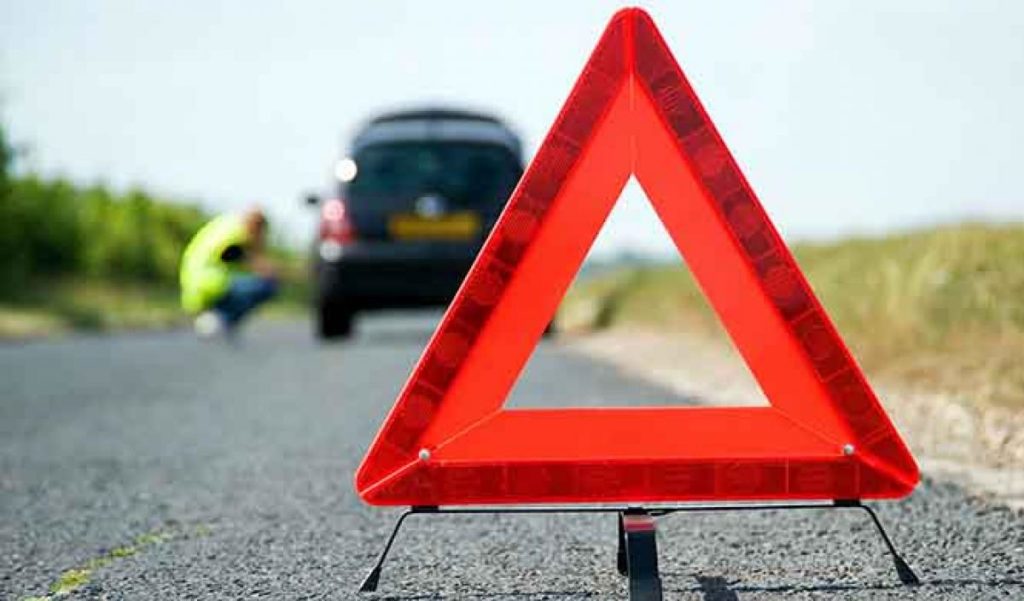
This signal will ensure maximum visibility on the road and, above all, will provide greater safety as it will communicate its activation, deactivation and geopositioning to the National Access Point for Traffic and Mobility.
In addition, it avoids the danger of having to get out of the vehicle to place the triangles. Until now, the legislation required the use of triangles to signal a vehicle stopped on the road due to a breakdown or accident. And this poses a serious risk to traffic because the driver had to move 100 meters to place the triangle, exposing himself to the risk of being run over.
Between 2018 and 2020, 42 people died on interurban roads after getting out of the vehicle and it has been found that many of these deaths were run over, either assistance service professionals who were attending an accident or drivers who got out to signal that they had suffered a breakdown on the road. And this system has another significant drawback: it cannot be used by people with reduced mobility.
Likewise, to advance in this line, the V-27 signal will be created: a 'virtual triangle' that will be activated in the vehicle's on-board system to warn of the presence of an approaching danger. This action will be voluntary and only those vehicles connected by telematic means with the National Access Point for Traffic and Mobility will be able to do so.
Press: Grupo Aseguranza.
#correduriaseguros #grupogalilea #mediators #brokerage #agents